
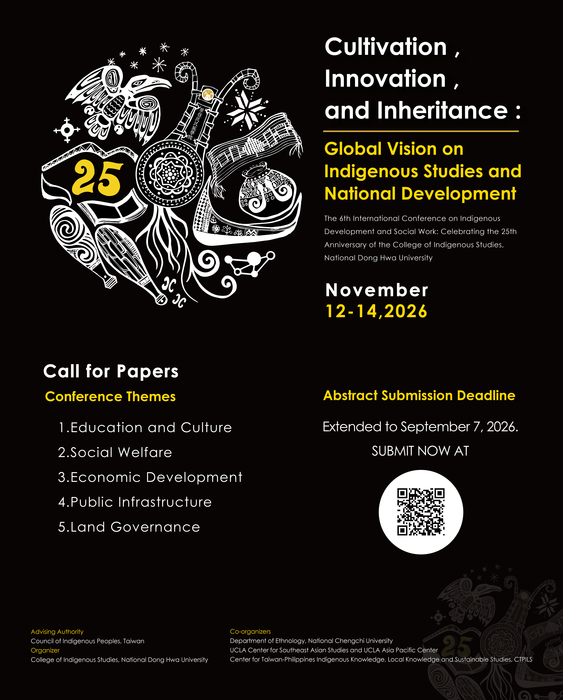
【Call for Papers】
The 6th International Conference on Indigenous Development and Social Work: Celebrating the 25th Anniversary of the College of Indigenous Studies, National Dong Hwa University
Theme: Cultivation, Innovation, and Inheritance: Global Vision on Indigenous Studies and National Development
I. Introduction
Since the beginning of the twenty-first century, Indigenous peoples worldwide have experienced profound social, political, economic, and environmental transformations. Under the influences of globalization, climate change, digital technological advancement, and evolving systems of governance, Indigenous peoples have continued to pursue cultural continuity, language revitalization, and self-determination while actively engaging in public affairs, knowledge production, and sustainable development initiatives. These efforts demonstrate the diversity and dynamism of contemporary Indigeneity and its growing global interconnectedness.
From land and natural resource governance, education and cultural preservation, health and social welfare, to technological innovation and digital sovereignty, Indigenous issues have become central to contemporary national development and global governance.
II. Conference Information
III. Conference Themes
The conference is organized around five major themes: Education and Culture, Social Welfare, Economic Development, Public Infrastructure, and Land Governance. We welcome submissions addressing, but not limited to, the following cross-cutting topics
Education and culture constitute the foundation of Indigenous knowledge transmission, cultural continuity, and identity formation. In an era characterized by globalization and digital transformation, Indigenous communities face challenges such as language loss, the marginalization of Indigenous knowledge systems, and the preservation of cultural heritage. At the same time, new opportunities for cultural revitalization and knowledge innovation continue to emerge. This theme explores Indigenous educational policies, cultural preservation and transmission, language revitalization, multicultural education, and digital learning, with particular attention to how education contributes to cultural sustainability and community development.
Indigenous well-being encompasses health, caregiving, social security, community development, and social justice. As Indigenous communities confront challenges such as population aging, health inequities, social exclusion, and historical trauma, the development of culturally appropriate welfare systems and service models has become a shared global concern. This theme examines the relationships among governance, social policy, and Indigenous well-being, highlighting practices of cultural safety, health equity, and community resilience.
Within the context of global markets and sustainable development, Indigenous economic development extends beyond issues of employment and industry to encompass cultural values, resource governance, and self-determined development. Promoting community revitalization, social enterprises, and innovative industries while maintaining cultural identity and ecological sustainability has become a critical challenge. This theme focuses on Indigenous economic self-determination, cultural industries, entrepreneurship, and Indigenous participation in global economic networks.
Public infrastructure plays a vital role in promoting sustainable development and enhancing quality of life in Indigenous regions. Infrastructure planning often involves issues of resource allocation, public participation, cultural sensitivity, and environmental sustainability. This theme investigates the relationship between governance and Indigenous participation, emphasizing infrastructure development that respects cultural rights, ecological conservation, and local needs while examining the impacts of smart technologies and digital transformation on Indigenous societies.
Land is not only fundamental to Indigenous livelihoods and development but also embodies cultural memory, historical experience, and collective identity. Amid climate change, resource extraction, and changing governance regimes, land governance has become a critical issue for Indigenous rights and sustainable futures. This theme focuses on land rights, resource governance, environmental justice, and self-determination, exploring approaches to land management that integrate cultural values, ecological sustainability, and effective governance.
IV. Submission Guidelines
Thank you for your enthusiastic submissions to the conference. Due to the larger-than-expected number of submissions, the abstract review process has taken longer than originally anticipated.
The organizing committee is currently continuing the review and compilation process and will make every effort to announce the list of accepted abstracts within this week.
We sincerely apologize for any inconvenience this delay may cause and greatly appreciate your patience and understanding.
V. Contact Information
For any further inquiries, please contact the conference committee: